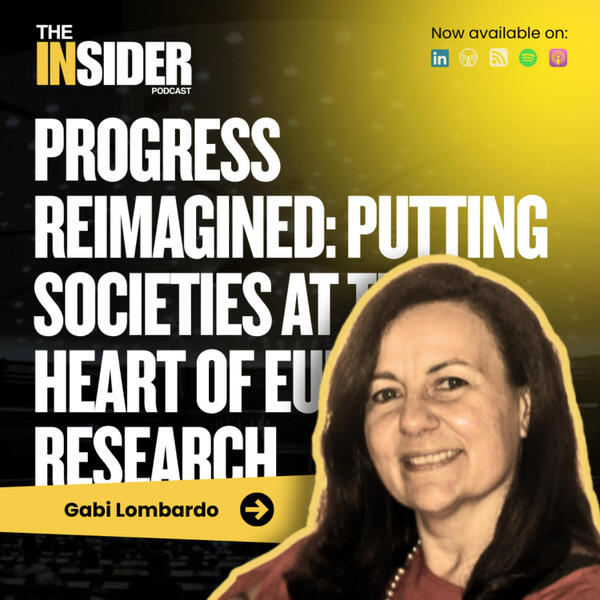
The Insider Podcast: Season 2 – Progress Reimagined: Putting Societies at the Heart of European Research
What happens when society becomes an afterthought in how we fund and govern science? And what would it take to put people back at the centre of the picture?
Ricardo Miguéis, Head of Office at INESC Brussels HUB, sits down with Dr Gabi Lombardo, EASSH Director and someone who’s spent years trying to fix exactly that. Gabi has seen the system from every angle, from the London School of Economics and the ERC to Science Europe and EASSH, and she’s built one of the strongest cases for treating the Social Sciences and Humanities (SSH) as co-designers of European R&I, not just background noise.
The episode unfolds in two parts:
Part 1 – Where we come from
Gabi reflects on her path, the institutional blind spots she’s seen up close, and why SSH remains structurally misunderstood in Europe.
EASSH is a movement created by researchers. Horizon Europe is the very first programme where integration is considered as a critical principle, and now being reconfirmed in FP10. The point is that the implementation is still rather weak (...) The contribution of SSH research is not being captured by the calls, and as a result it remains limited in the projects. The policy design needs to be updated to capture the type of research SSH researchers do today. There is still a lot to do in designing multidisiplinary programmes. – Gabi Lombardo
Part 2 – Where we go next
The conversation dives into FP10, and the new Society policy window, asking what it would really mean to let SSH research deliver critical knowledge on our societies and contribute to other fields rather than commenting from the sidelines.
The Society window needs to fund research on society and SSH specific research questions (democracy, education, cultural diversity, etc.). At the same time, we need to provide opportunities to integrate social and humanities questions across all the other knowledge domains, going beyond the Society policy window. FP10 must include societal challenges across the whole programme. Humanitarian and social innovative projects were the lifeline for several people locked indoors during COVID19. We need to understand innovation also in terms of savings, which is more common in social policies, rather than only in terms of generating cash. The problem is that at the moment policymakers do not have instruments to calculate the value added of such innovation. (...)
The reason Europe has one of the best standards of living is that we have different policies, we have been building regulations for a purpose, for protecting our citizens. We need to be more ambitious in changing the metrics for the societal value generated beyond just money. A better effort to implement a "beyond GDP" narrative is crucial, particularly for understanding innovation, competitiveness and investment in R&I. (...)
Why don't we put the funding where our values are? Some of the most successful European industries have been left out from the competitiveness fund, like for example the creative and service industries. These are based on high-value research efforts in the arts and humanities, as well as accountancy and management. Yet, they seem to be disconnected from the overall R&I investment." – Gabi Lombardo
Gabi explains how EU diplomacy works and the layers of complexity around European research. She points out that there's a need for evidence-based governance.
Many of the European policy reports offer plenty of data, but not an analysis. But what does it mean if a programme has 40% more applicants or 20% less patents? We really need to address evaluting the currrent programme in context. Programme assessments must lead to improvements in the future, and this will only happens if there is more more anaytical and critical thinking, not just collecting numbers."
The position paper Gabi mentions came out on 7 November. Read more.
Listen now to Episode 1: Progress Reimagined: Putting Societies at the Heart of European Research.